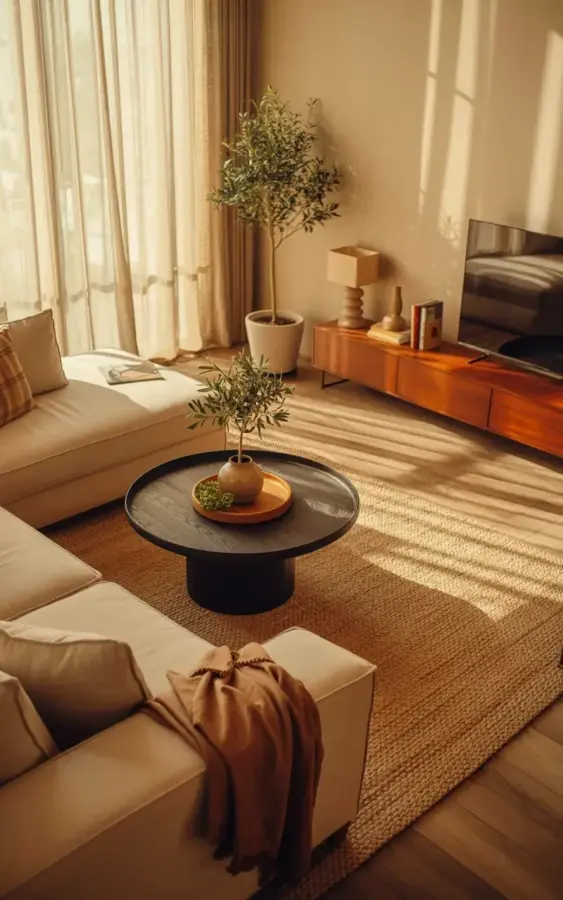
Picture a living room where the light does most of the decorating. Sunlight pours through the glass, washing over a low beige sectional, and for a second you forget the world outside. That is the exact feeling we are chasing in this guide. I want to walk you through how to build a warm minimalist living room around a beige sectional and natural wood decor, using the room you see in the photo as our blueprint. This is for the absolute beginner, someone who might not know a lumbar pillow from a floor cushion but knows they want a home that feels calm and genuinely inviting.
I have rearranged furniture more times than I care to admit, and I have made every mistake in the book. So trust me when I say that this style is forgiving. It is not about perfection or empty, cold spaces. It is about warmth, texture, and letting a few good pieces do all the heavy lifting.
## Why a Warm Minimalist Living Room Works for Beginners
A lot of people hear the word minimalism and picture a sterile white box with one sad chair in the corner. Not this version. A warm minimalist living room balances negative space with rich materials and soft, earthy tones. You keep the clutter low, but you do not sacrifice comfort. The room in our photo is the perfect example: it feels open, but the jute rug, wooden details, and olive tree give it a lived-in soul.
For a beginner, this is the smartest starting point. You do not need a huge budget or a design degree. You need a few foundational pieces that work together, then you stop. The secret is to choose items in a similar tonal family, like warm beige, brown, and natural fiber, so even if you make a small mistake, the room still feels cohesive.
Let me also be honest about the practical side. This style is forgiving when it comes to daily life. A beige sectional sounds scary if you have kids or pets, but today’s performance fabrics hide a lot. And the natural wood coffee table? It develops a patina over time. A scratch here and there just adds character.
## The Beige Sectional as Your Living Room Anchor
Choose the sofa first. That is my rule, and I am sticking to it. The beige L-shaped sectional in the reference photo is not just a place to sit; it sets the entire color palette and the mood of the room. When you pick your own, look for a fabric that feels soft but durable. Something like a textured weave or a high-performance polyester blend will give you that cozy feel without making you terrified to use your own living room.
The size matters more than you think. An L-shaped sectional anchors a room because it defines the seating area, but it can easily overwhelm a small space. Measure your room before you buy. Go one step further and tape the dimensions out on your floor with painter’s tape. It sounds ridiculous, but it saves you a huge headache when the delivery truck shows up.
When you style your sectional, do not overdo it with pillows. In the photo, there is one brown throw blanket casually draped over the end. That is it. The restraint is what makes it look expensive and serene. If you want to add a couple of pillows, stick to earthy tones like taupe, rust, or soft cream. Keep it minimal so the eye rests, not bounces around.
## Why a Jute Rug Makes the Whole Room Calmer
Here is the thing about a jute rug: it is the unsung hero of the neutral living room. The one under the sectional in our photo does not just protect the floor. It adds a layer of texture that softens the hard wood surfaces and defines the entire seating area. Honest moment: jute is not the softest thing under your feet at first. It has a natural, rough weave that takes a few weeks to settle in and break down.
But the visual reward is huge. Jute brings that organic, beachy, warm element that you simply cannot get from a synthetic rug. It grounds the beige sofa and the dark wood coffee table, creating a natural trio of textures. When you shop for one, do not confuse jute with sisal. Sisal is harder and rougher. Jute has a warmer, more golden tone that suits this style much better.
Make sure you grab a rug pad. I cannot stress this enough. A jute rug can be a little slippery on hard floors, and a good felt pad underneath will keep it from sliding when the kids jump on the couch. It also prevents the natural fibers from scratching your wood flooring. Two birds, one stone.
## Mixing Dark Wood and Light Textures Like a Pro
The dark wooden coffee table in the center of the room is a masterclass in contrast. It is round, solid, and rich in color, sitting right on top of that light jute rug. Here is the lesson: warm minimalist living room decor works best when you balance light upholstery with darker accents. The sofa is the light. The table is the dark. Together, they stop the room from feeling washed out and one-dimensional.
Do not be afraid to blend wood tones in your living room decor. The media console against the wall is a long, rich brown piece, while the coffee table is darker, and there is an olive tree in a simple pot. They do not match exactly. That is fine. In fact, that is the point. In a natural aesthetic, furniture should look like it was gathered over time, not bought as a matching suite.
The round shape of the coffee table is also a smart choice. It softens the strong lines of the L-shaped sectional and the rectangular media console. Round tables are also safer for families. No sharp corners to catch a toddler’s forehead or your own hip when you walk by in the dark. I learned that one embarrassingly.
## Styling the Long Media Console Without Creating Clutter
The wooden media console is where the practical and the beautiful collide. It holds the television, a few books, decorative items, and a lamp, but it still looks organized and calm. How? The rule here is to group similar things together and leave breathing room around each object. Do not spread items out evenly across the whole surface. Cluster three books together, put the lamp on the other side, and let the middle remain clear.
Here is an important tip for the TV itself: do not feel pressured to hang it above the console. In the photo, the TV is sitting directly on the console. This keeps the visual weight low and the room feeling grounded. If you mount it, you introduce a large black rectangle into your carefully curated neutral space, and that can kill the vibe. Keep it on the stand or get a frame-style TV that looks like art when it is off.
Lighting matters more than you think. A table lamp on the media console adds warm, localized light for the evening. You want warm-toned bulbs, around 2700K, not the clinical white light that makes a room feel like a doctor’s office. A lamp with a linen shade, a few books, and maybe a small ceramic bowl for keys is all you need. Resist the urge to fill every inch.
## Bringing Life Into the Living Room With an Olive Tree
That olive tree by the window is doing so much heavy lifting. It brings height, a pop of green, and a feeling of life into the space. A neutral living room runs the risk of feeling flat and lifeless without some botanical element. But if you have a black thumb like me, do not panic. Olive trees are forgiving, but they do need sunlight. If you do not have a bright window, try a snake plant or a ZZ plant. Those things survive on pure neglect.
The pot matters almost as much as the plant. A simple terracotta or ceramic pot in a warm earth tone keeps the look cohesive. In the photo, the olive tree sits in an unassuming container that lets the foliage and the sunlight do the talking.
Placement is everything. Put the plant near the window to catch the light, but not directly in the path of harsh afternoon sun, which can burn the leaves. If your space lacks natural light, honestly, just buy a high-quality faux olive tree. The difference is minimal these days, and it saves you the guilt of killing a living thing. Not gonna lie, I have had to apologize to many plants in my lifetime.
## Simple Styling Rules to Keep Your Living Room Decor Cohesive
By now you know the basic pieces, the sectional, the rug, the wood table, the console, and the plant. But how do you tie it all together without it looking like a showroom? My best advice is to limit your color palette to about three or four main tones. Beige, brown, cream, and green, that is it. When you add a throw blanket or a vase, it should fall somewhere in that range. This instantly makes a room feel curated and intentional.
Use the concept of odd numbers when arranging small decor. Place items in groups of three. A stack of books, a small ceramic vase, and a brass dish. It is an old stylist trick, but it works because the eye likes an odd number of focal points. It creates a natural, organic feel that perfect symmetry cannot match. Break the rules sometimes. Put the vase off-center. Leave a blanket crumpled on the arm of the sofa. Perfection is the enemy.
Look, I have seen so many people stress over making their homes look exactly like a magazine spread. Then they light a candle and immediately knock over a stack of magazines trying to be tidy. Stop doing that. A warm minimalist living room is about how the space makes you feel. If you sit down on that beige sectional at the end of the day and your shoulders drop, you did it right.
Putting together a space like the one in the photo comes down to balance and patience. Start with the big pieces, let the rug and the wood do the talking, and slowly add the smaller personal touches over time. Don’t rush it. Good rooms evolve, and a mix of furniture, green life, and soft textiles is the easiest way to make a house feel like your home.
I hope this guide gives you the confidence to start rearranging your own space. Grab a tape measure, a pen, and a notepad, and sketch out where your sectional will go. Then build outward from there. The materials, the texture, and the golden sunlight will handle the rest. Save this post for later when you are ready to shop, and remember, the best rooms are the ones that make you want to slow down.
Leave a Comment