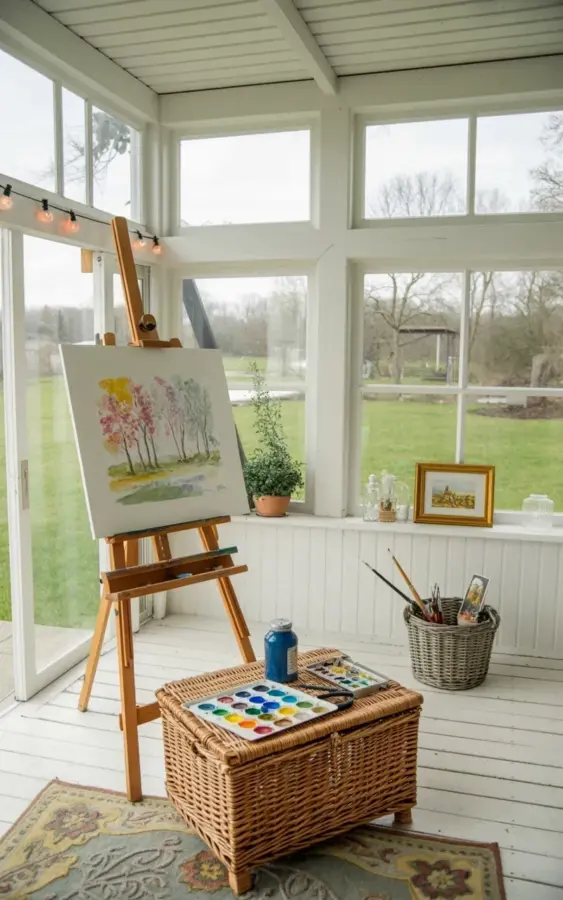
I get it, the dream of painting in a sun-drenched room. Honestly, unless you have a whole separate house, finding a workspace that gets decent light is half the battle. And look, I know we can’t all build a professional atelier. But this photo right here? It’s proof that you just need a corner, a plan, and a bit of natural sunlight to make something you actually want to use every day.
I’ve been staring at this specific sunroom art studio ideas board for a while now, and this bright watercolor corner is the one that keeps pulling me back in. The easel is tucked right by those high windows, which is genius for keeping your shadows soft. But it’s the unexpected bits, the big wicker ottoman and the squat little rug, that make it feel doable. It’s not some sterile gallery space. It feels like a place where you could spill some water and just blot it up with your sock.
In this post, we’re going to break down exactly why this setup works. I’m going to walk you through a few different themes you can steal from this image, depending on how you actually like to create. So grab a cup of something warm and let’s get into it.
## How to Use Natural Light Without Glaring at Your Canvas
The absolute hero of this sunroom idea is the window placement. The easel isn’t facing the window dead-on. Instead, it sits off to the side, letting the light hit the canvas at a gentle angle rather than blasting your eyes with glare. That’s a huge, huge deal.
If you can arrange your easel so the light comes from your shoulder or slightly behind your supporting hand, you’ll avoid casting shadows across your paper. You don’t need to buy expensive daylight bulbs if you can get one good window like this. Also, try putting a small mirror somewhere in the room to bounce extra brightness into dark corners. For watercolorists, soft, diffuse light is the ultimate goal, and the white walls here act as a giant reflector.
## Make a Wicker Ottoman the Focal Point
I love a coffee table as much as the next person, but this wicker ottoman is actually a better studio companion. It’s softer on the edges, so you can lean over it without bruising your ribs. And the surface texture? It grips things. That little tin of water or your scrubby brush won’t slide around when you’re reaching for them mid-paint.
Here’s the trick: you want a workspace that feels temporary. If you use a massive desk, it accumulates mail, laptops, and old receipts. An ottoman? It stays clean because it’s separate from the rest of your living chaos. It’s barely big enough to do anything else, so it forces you to keep it artistic. Put your palette on one side and a small, damp rag on the other for wiping brushes. You’re set.
## The Case for Low Storage and Floor Level Supplies
In this photo, there’s a woven basket sitting right on the floor by the window. It’s not on a shelf, it’s not in a cabinet. Just chillin’ by the plant.
Look, this is great for your posture and your flow. When you stand at an easel, you tend to lock your knees and hover over your work, which ruins your back. Having to crouch down or sit on a stool now and then to grab a fresh tube of paint or a new sheet of paper is actually a welcome reset. It changes your eye level, so you can see your composition from a new perspective.
– Keep a small basket for **odd-sized scrap paper** (it’s always a weird size).
– Toss in **replacement watercolor tubes** so you don’t have to stop mid-mood.
– Use a liner near the top for **pens or water-soluble pencils**.
Sometimes the best studio furniture is just a thing you already own, placed near where you work.
## Watercolor Palettes and a Touch of Clean Storage
Ok so let’s talk about the palette in the image. It’s got that classic grid, with wells for blues, oranges, and a bunch of greens. You want to keep that thing out in the open. The day’s mixing session should look messy and appealing, that’s how you get inspired to start again tomorrow.
Leave your palette on the ottoman, or right next to it. That alone is a visual invitation to sit down and paint. If you pack it away in a drawer, you will forget about it for a week. I’m not saying be a slob, just keep your active work dirty and ready. For everything else, use that blue glass jar on the carpet. It’s the perfect height for holding brushes handle-down while they air dry, but it’s heavy enough that it won’t tip over when you jam a brush in.
## Let a Little Plant Bring Life to the Easel
This might sound silly, but painting at an easel can be a solitary, static activity. You look at your paper, you mix paint, you look at the paper again. Having a small potted plant at your feet, or in your line of vision, gives your eyes a relaxing place to rest.
It’s also a great control subject. When your watercolor trees with pink and yellow foliage start to feel wonky, look at the actual plant on your floor. Study how the light filters through its real leaves. You can learn more about translucent washes from a living plant than a whole tutorial video. Plus, if you are working with white floors, that little pop of green prevents the room from feeling sterile.
## Rug Ideas: Grounding the Space for Barefoot Painting
Hardwood floors are pretty, but they are acoustically dead. They echo when you drop a pencil and they make your feet feel icy in the morning. That’s where the soft rug comes in.
Don’t choose a thick, fluffy high-pile rug for a studio. You’ll get pigment dust stuck in it, and you’ll trip over the shag. Go for a flat weave or a low-profile cotton rug, like the one shown here. It delineates the “painting zone” from the “walking zone”. It’s also a lifesaver if you drop a brush or a wet sponge. Cleanup is just a matter of picking it up and tossing it in the laundry. Keep a pair of slippers nearby if you really love the white wood look, you’re gonna need them.
## It Doesn’t Have to Be Perfect to Be Functional
The biggest takeaway from looking at this room is that everything is slightly imperfect. The easel is wooden and worn. The paints are scattered. The painting in progress has organic, blobby trees.
I genuinely believe that’s the point. You don’t need custom cabinetry to make an art studio work. You need a tiny area where your brain goes “ok, we’re painting now.” Maybe that’s a big wicker footstool. Maybe it’s just a plank of wood over two boxes.
Here’s the secret (and it’s not really a secret): the more “lived-in” your studio feels, the more often you’ll use it. A pristine studio makes you feel like you need to put on an apron and be serious. This space? It looks like you can just drop in, paint a tree, mess up, and walk away for a coffee.
So take the leap. Move that easel next to a window. Put a plant within sight, and maybe just let your paints live outside the drawer for a week.
**Do you have a specific corner in your house that could become your happy place?** Let me know in the comments, and share a photo of your favorite creative nook, I’d love to see what you’ve built!
#sunroomideas #artstudio #watercolor #cozyhome #roomdecor
Leave a Comment