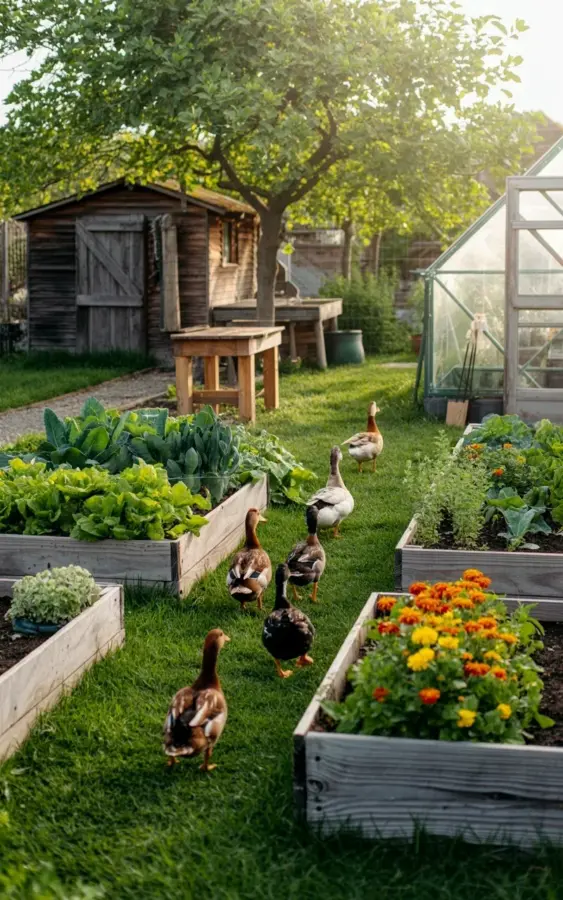
The photograph that started this whole post is basically a perfect Saturday morning. You can almost feel the warmth on the weathered gray wood of the planter boxes, and you can practically hear the contented little quacks echoing off the rustic shed in the background. It is a scene straight out of a dreamy lifestyle magazine, but the reality is, it wasn’t luck. It took a few seasons of trial and error to get to that serene point where five ducks can wander the pathways without destroying the harvest.
If you are currently standing in your backyard trying to figure out why your tidy raised bed vegetable garden looks more like a war zone, I get it. I have absolutely been there. This article is going to walk through the common mistakes I made when trying to merge my love for a structured garden with the chaos of free-range birds. We are going to look at the scene in that photo: the ducks, the greens, the marigolds, and the mess-ups that happen before it ever looks that good. Let’s get into the nitty-gritty.
Mistake Number One: Making the Paths Too Narrow for Your Garden Ducks
Look, in the photo, the grass pathways between the raised beds are wide. They are not just decorative; they are functional highways. My first year, I built my beds as close together as physically possible to maximize planting space. I crammed the walkways to a width of about eighteen inches. It looked great on paper for a human, but as soon as the garden ducks arrived, it became a disaster.
Ducks are bulkier than they look, and they hate feeling trapped. When the path is too narrow, their wings brush against the plants, they panic, and they flap. That creates a tornado of dirt and shredded lettuce. You need at least two to three feet of clearance for the birds to move comfortably. It feels like wasted space, but honestly, it is the only way to keep the peace. Plus, those wider paths become lovely areas for the ducks to lounge in the sun, which adds to the “cottage garden inspiration” vibe you are actually going for.
Mistake Number Two: Forgetting That Veggies Are a Snack Buffet
Here is the thing about letting ducks into a raised bed vegetable garden: They don’t see your hard work. They see a salad bar. In the image with the three brown and two black ducks, the boxes are packed with leafy greens. I learned the hard way that if you plant a bed full of young, tender lettuce and just open the gate, you will have nothing left but little green stubs by lunchtime.
The fix isn’t to keep the birds out entirely. The fix is timing and protection.
– **Plant sturdy, mature plants:** If the greens are established and large, ducks will nibble but usually won’t wipe the whole row out.
– **Distract them with better food:** Ducks love slugs, worms, and weeds. Let them in to hunt, not to eat your spinach.
– **Use netting early:** Cover the young transplants until they are at least six inches tall. It saves the crop and your sanity.
Ducks are the absolute best pest control, but you have to manage their grazing habits before they treat your heirloom tomatoes as their personal afternoon snack.
Mistake Number Three: Ignoring the Digging and Puddling Behavior
Ok so, the photo shows a pristine, green lawn with five ducks standing politely on the grass. That is a carefully managed moment. Let me tell you, ducks are mud machines. They have a natural instinct to dig for grubs and, most importantly, they are obsessed with water.
If you leave out a water dish, they will bathe in it. They will splash the muddy water all over the sides of the planter, and they will compact the soil around the roots of your marigolds into a concrete mess. I remember finding a black duck happily wedged into a gap between the soil and the lip of a wooden planter, creating a crater that looked like a bomb had hit it.
To avoid this, use a poultry nipples system or a shallow dish that you *always* keep in the same corner, far away from the beds. And never, ever let them see you turn on the garden hose. They will come running, and they will dig a wallow in the wettest, most inconvenient spot they can find. It is a constant battle between their love of water and your desire for tidy rows.
Mistake Number Four: Sticking to Strict Rows Instead of Cottage Garden Chaos
The term “cottage garden inspiration” gets thrown around a lot, but looking at that weathered wood and the mix of herbs and vegetables, the magic is in the mixing. My initial approach was military precision: exact rows for onions, exact rows for carrots, and a strict no-flowers policy. It looked sterile, and honestly, it made the garden a target for every pest in the neighborhood.
Ducks don’t care about rows. They wander, and they look for bugs hiding under leaves. If you intermix the lettuce with the onions and scatter the marigolds throughout, you confuse the pests but not the birds. The ducks will actually hunt more effectively when the planting is dense and a little bit wild. The visual result of that “organized chaos” is much more charming than any sterile grid. It is functional, and it photographs beautifully.
Mistake Number Five: Not Building a Sturdy Workbench or Focal Point
In the background of the photo, there is a rustic wooden shed and a workbench. This is not a mistake I made by having one; the mistake was spending two years using a flimsy plastic folding table that blew over in the wind. A raised bed vegetable garden is work. You need a proper place to hold your pots, your trowels, and your ten-pound bag of duck feed.
That wooden workbench in the image serves as a crucial visual anchor. It grounds the whole scene. When you are in the garden early in the morning, surrounded by ducks, it is so much easier to pot up a seedling when you have a sturdy surface that is the right height. It also gives the birds a spot to perch (and yes, they will perch on it and leave little gifts, but that is part of the charm). Build it heavy, build it weatherproof, and secure it to the shed. Your back will thank you, and the garden will finally look finished.
Mistake Number Six: Overwatering or Creating Mud Pits
Back to the hydration problem, because it deserves its own spotlight. In the photo description, the garden is bright and sunlit, and the greens look vibrant. What you don’t see is the mud bowl effect. Ducks are aquatic birds; if the ground is saturated, they will hammer it into a quagmire. It ruined my walking paths for an entire season. The grass died, the soil turned to slick clay, and my boots were perpetually caked in a solid three inches of muck.
The solution is water management. Use drip irrigation on a timer in the raised beds, as opposed to a standing sprinkler that drenches the entire lawn. This keeps the walkways dry. If you must water by hand, do it in the morning so the soil has time to absorb before the ducks come marching through at mid-day. Ducks are fine with a little moisture, but they cannot resist a puddle. A dry path is the only path.
The Real Secret to a Backyard Garden With Ducks
So, after all that trial and error, what is the actual secret that gets you to that golden hour snapshot? It is a combination of patience and accepting a little bit of mess. You have to let go of the idea of a perfect, sterile garden. The ducks are going to eat a few of your leafy greens. They are going to make noise, and they are going to dig a hole somewhere you wish they wouldn’t.
But, they are also going to eat your slugs, fertilize your soil, and stand in your garden looking so impossibly cute that you forget about the chewed leaves. Spring garden ideas do not get much better than this. It is a balance of giving the birds enough room to be themselves while protecting the specific plants you actually want to harvest.
Start small. Give the birds one dedicated area to forage and protect the beds until the plants are established. Before you know it, those five ducks will be following you around the yard like feathery puppies, and your raised bed vegetable garden will be the liveliest corner of your property.
It is a messy, muddy, wonderful way to garden. And honestly, I wouldn’t trade it for a perfectly manicured flower bed any day. If you are ready to try it, just remember to widen those paths. Your back, and your future lettuce, will totally appreciate it. Have you ever let birds roam through your veggie patch? I am genuinely curious if your ducks are as chaotic as mine.
Leave a Comment